
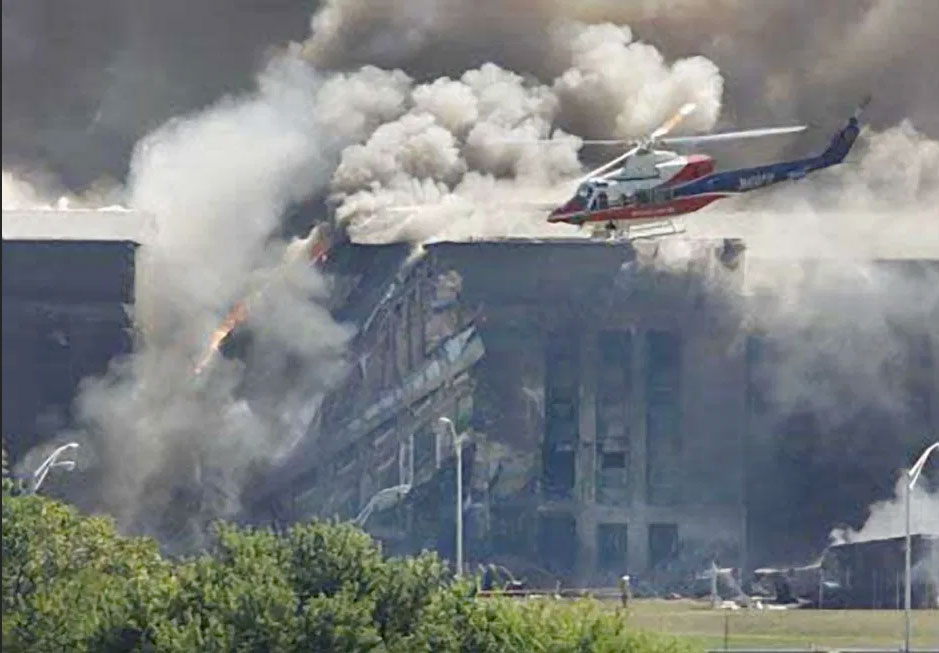
I was in Washington, DC, working on an assignment on Sept. 11, 2001 when my Blackberry email pager vibrated with a short message: “Explosion at the Pentagon. Get there!” It was a warm morning and I had the top down on my Wrangler as when I dropped my cameras in the passenger seat. When I drove out of the garage, I saw smoke rising in the direction of the Pentagon. The 14th Street was closed, so I headed into Southeast DC to a bridge over the Potomac River next to the Washington Navy Yard. The yard had Marines with M-16s standing guard at the entrance. The stoplight leading up to the bridge was red, so I raised my Canon with a 80-200m zoom and show a photo of a female Marine with an M-16 with a bayonet and took a half dozen shots before the light changed and I crossed the bridge to I-295 to the Beltway and then south on I-395 to the Pentagon.
Parking on the side of Columbia Pike, I grabbed my two camera and a bag of lenses and batteries and cards to scramble up to a hillside overlooking the Pentagon and the gaping hole with fire and smoke flowing from it. It was start of a long day and into the night taking photos of the event.
Tomorrow, America stops to remember that day. I spent more than six decades as a newspaperman and photojournalist, chasing stories around the globe while the biggest story of our times occurred just a few blocks and just across the river from my office. The plane that slammed into the Pentagon was a direct attack by a team of hijackers who also took down the twin towers of the World Trade Center with two other commercial airliners. A fourth was also headed for Washington, but crashed in Pennsylvania after passengers took control.
When I got home well after midnight on that fateful day, a note and business card stuck in the door jam was from a “Special Agent Ryan” of the Naval Criminal Investigative Service, asking me to call him. After waking up after a short nap, I called. He said I had been seen at the Navy Yard taking photos on the morning of Sept. 11 and wanted to know “your purpose for being there.”
I explained that I was waiting for the light to turn to get on the bridge and saw the unusual activity of the Yard and took a few photos, from my Wrangler. I explained that I was headed for Pentagon to take more photos and cover the crash of the plane. Several of my photos, including the Marine on guard at the Navy Yard was sent out over the wire service I was contracted with at the time. He said he had seen them.
He thanked me and said that should take care of his investigation on the matter.
At the Pentagon the day before, a fellow photographer and I were talking. He looked at the burning hole in the building and the medics working on victims and said: “I think the America we have known has changed forever.”
He was right.